Kyber: It's Time for Real-Time
Making Distance Disappear
tl;dr: we raised $5M to build Kyber, the real-time infrastructure for machines and Physical AI: control, observe and manage any machine, anywhere in the world. It’s open source, with commercial offerings, written from scratch in Rust, on top of VLC and FFmpeg. It streams video, sensors, control and data in real time, over long distances. And we’re hiring.
When you’re watching a video, an extra 200 ms of latency rarely matters. When you’re controlling a machine, it’s a very different story.
That’s, more or less, why Kyber exists.
Earlier this month, we announced a $5M seed round for my new company, Kyber, led by Lightspeed, with OVNI Capital and Kima Ventures. I’ve spent most of my time on Kyber over the past months, and written almost nothing about it here. Time to fix that.
Why Kyber?
More and more, the machine, the compute and the operator are not in the same place.
A small robot or a drone can’t carry all the computing power, batteries or data it would need. A surgeon or a specialized engineer can’t be physically everywhere. An autonomous vehicle still needs supervision and, from time to time, a human to take over. Complex 3D universes don’t render on your phone. And increasingly, the operator isn’t a human at all, but an AI running on a GPU somewhere else.
We’ve partly solved this for computers, with remote desktops, cloud gaming and cloud applications.
The problem gets much more interesting with physical machines: several cameras, microphones, sensors and actuators, over networks that are rarely as good as you’d like. The moment a human or an AI has to observe, decide and act on a distant machine, the network becomes part of the control loop.
With Kyber, we want to make that distance disappear. On all platforms, for all use cases.
Physical AI needs a nervous system
Every generation of computing needs new infrastructure. The web got HTTP and CDNs. The cloud got virtualization. Video got codecs, players and streaming protocols, and I spent twenty years on that one.
Machines and Physical AI need theirs: a real-time nervous system connecting humans, AI agents and machines, anywhere in the world. It doesn’t really exist yet. We’re building it.
Collecting synchronized data from thousands of robots, training them through human demonstration, watching what they do, letting a human step in, spreading inference across machines: many of these are fundamentally infrastructure problems, not AI problems.
I also don’t think teleoperation and autonomy are competing technologies. Teleoperation is how many robots learn in the first place. And there will be a continuum, from human-operated machines to AI-assisted operation, supervised autonomy and full autonomy, sometimes within a single mission.
The more autonomous machines we deploy, the more that nervous system matters. With VLC, we made it possible to play any video, on any device, anywhere. With Kyber, we want to make it possible to control, observe and manage any machine, from anywhere.
What is Kyber?
Kyber is infrastructure for machines and Physical AI: the software to control, observe and manage machines in real time, anywhere in the world, from a single machine to entire fleets.
We provide the whole stack: server, client, protocol and an extensible SDK. The server captures pretty much anything, from a full desktop or a single app to a 3D engine, cameras or an HDMI feed. The client runs natively, on an XR headset, or in a browser with nothing to install.
At the core is high-quality, ultra-low-latency video streaming. But we’ve extended it to carry audio, LiDAR, depth, positioning, IoT sensors and all sorts of bidirectional controls, synchronized and multiplexed over one secure connection.
On top of that, Kyhub, our management portal, handles the whole lifecycle of a fleet: users and machines, access control with SSO, real-time monitoring, metrics, logs and recordings. Controlling one machine is the easy part. Observing and operating hundreds of them, day after day, is where infrastructure really matters.
I don’t think every company building robots should also have to build a multimedia and networking stack. It’s a lot of work, and I know a thing or two about that. :)
What for?
The same SDK covers a surprisingly wide range of applications:
- Remote desktop: our first vertical, and the technical base for everything else. High-performance remote workstations, application streaming and modern, sovereign VDI.
- 3D and XR: rendering complex scenes, simulations and digital twins on remote GPUs, straight from Unity, Unreal or OpenXR applications, and streaming them to lightweight devices and headsets.
- Robotics: teleoperation, fleet management, supervision, and synchronized data acquisition to train robotic models.
- Drones and autonomous vehicles: real-time control and observation of single machines, fleets and swarms, on land, in the air or at sea.
- Healthcare: medical robotics and remote assistance, where latency is a safety issue, not a comfort one. With Avatar Medical, we were selected as France 2030 laureates, announced at Laval Virtual in April, to bring immersive, patient-specific 3D imaging to hospitals, rendered remotely and streamed in real time.
- AI visual agents: letting AI systems observe and act on their environment in real time, including by controlling other machines. Fast inference doesn’t help much if your media stack adds 200 ms.
Remote desktop is where we start commercially, not where we stop: robotics, XR, healthcare and AI agents all run through the same portal, and Kyhub can become a real console for all of them, not just desktops.
We’ve even started building our own robots and drones to test all this, from a 3D-printed rover with an arm to long-range drones. After years of debugging video decoders, debugging a flying machine is a nice change! So is driving a rover in Las Vegas from Paris.
Latency, latency, latency
In VLC, we add buffering so playback stays smooth on bad networks. For remote control, that is exactly the wrong reflex.
When you operate a machine, you make decisions based on what that machine tells you. The older that information, the worse the decisions. I’d rather have a few corrupted pixels now than a perfect frame 100 ms late. And when the feed falls behind, Kyber shows the latest frame and drops the rest.
So we’ve spent a lot of time optimizing the whole chain: capture, encoding, memory copies, GPU transfers, networking, decoding and rendering. Some glass-to-glass numbers from our lab, for desktop streaming:
| Client | Refresh rate (Hz) | Codec | Latency (ms) |
|---|---|---|---|
| Native | 240 | H.264 | ~8 |
| Native | 120 | H.264 | ~12 |
| Native | 60 | H.264 | ~16 |
| Browser | 120 | HEVC, hardware decode | ~16 |
At 60 Hz, 16 ms is a single frame, so the refresh rate matters a lot. And the network adds its own delay: we haven’t found a patch for the speed of light yet.
Video-call stacks typically live at 100 to 200 ms in the real world. The lower you go, the less remote control feels remote, and applications like interactive AI agents or remote surgery become technically conceivable.
The Kyber team
The thing I’m probably proudest of is the team.
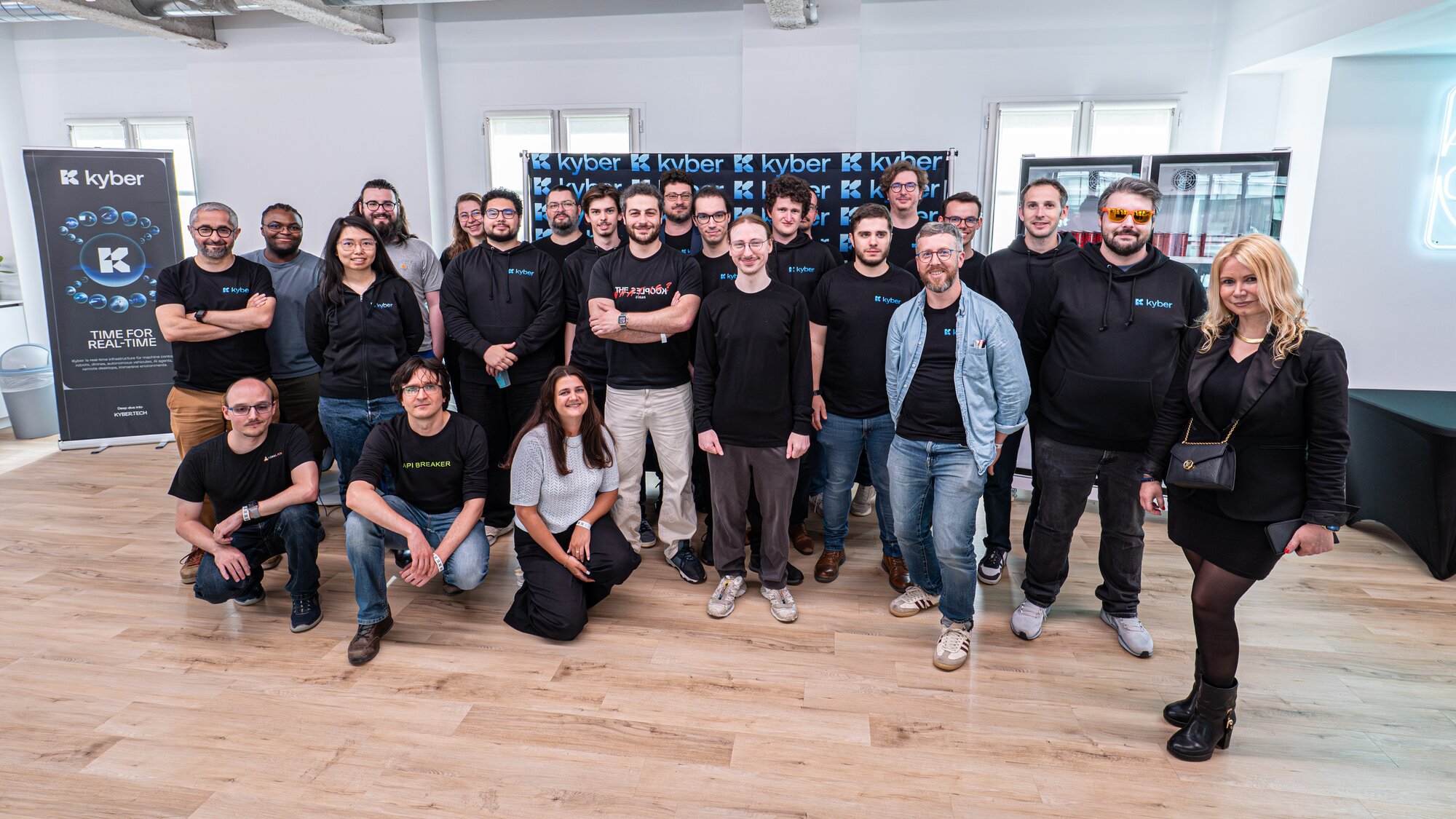
We’re a team of geeks, with expertise in multimedia, networking, operating systems, embedded software, electronics, radio, robotics, 3D and AI. Some come from the open source communities I’ve been part of for years. Others bring skills from fields that are completely new to me.
We also have excellent people on product, design, sales, marketing, support and operations: everything it takes to turn good technology into good products and a real business.
There aren’t many places where you can discuss AV1, congestion control, Windows internals, radio firmware and robotic arms in the same office. I’ve always wanted to work with people who are both very good at what they do and good human beings, who challenge each other and aren’t afraid to tell me I’m wrong. I learn a lot from them.
What impresses me most is how fast this team goes from an idea, or a fairly obscure technical problem, to something that actually works. Looking at how much 26 employees have built in so little time, I’m still a bit amazed. And we have a lot of fun doing it.
Our main office is in Paris, with a presence in San Francisco and Singapore, and people working from several other countries.
A huge thank you to Julien Zouein, Natacha Holtzhausser, Simon Latapie, Romain Roffé and Ilhan Gendron, who embarked on this adventure with me, and to the whole Kyber team. You’ve done an amazing job getting us this far. Most of what’s in this post is your work, not mine.
A few technical bits
The Kyber protocol is built on QUIC: independent streams, datagrams, congestion control and TLS 1.3, all in one connection, on one port. Network administrators like that part.
Different types of data needs different rules. Losing a key-release event is a bad idea: you get a stuck key. Retransmitting an old video packet across an ocean is an equally bad idea. So control messages travel on reliable streams, while media can use datagrams protected by RaptorQ forward error correction, which, as long as enough repair data gets through, rebuilds a damaged frame without waiting for retransmission. The right transport mode depends on the network, so it’s chosen at runtime.
One rule drives the receiver’s delivery deadlines: receiving more data must never push back the moment a frame is delivered. It sounds obvious, until you notice how many buffering strategies extend their wait every time a new packet shows up.
Clocks are another fun problem. Cameras, microphones and other sensors all have their own clocks, and they drift. If you know MPEG-TS, think PCR, re-derived for IP: a master clock in the muxer keeps every stream, including the controls, on the same timeline. That is essential when you record data to train robotic models.
Kyber is a completely new codebase, written from scratch and released as open source. Most of it is in Rust, and for the multimedia parts we reuse what we know best: VLC and FFmpeg. We support the major codecs, including AV1, and a long list of hardware encoders and decoders. The web client is the same Rust code compiled to WebAssembly, on top of WebTransport and WebCodecs.
No WebRTC. On purpose. It’s great for video calls, but in a closed loop where we own both ends, the buffering and reliability policy is the product, and we need to own it. Media over QUIC is a different story: it’s the right architecture for distributing live media at scale, and I think the two will compose nicely.
I’ll go deeper into the receiver deadline algorithm, FEC versus retransmissions, clocks and MoQ in future posts.
Open source, of course!
Kyber is dual-licensed: almost everything is open source under the AGPL v3, and also available under a commercial license. The code is on GitLab.
We care a lot about portability, extensibility and proper APIs, in C, C++, Rust, Python and JavaScript. Our own applications use the exact same SDK as our customers, with no private API.
I’d love to see developers use Kyber for things we haven’t even thought of, the way people have done with libVLC and FFmpeg for years.
And when your business depends on controlling physical machines, you should be able to inspect the software, modify it, and run it on your own infrastructure.
Open beats closed, always.
A global company, built from Europe
Europe has the engineers, the research and, increasingly, the entrepreneurial ecosystem to build major software companies. We should be more ambitious about it.
I don’t want Kyber to be the European alternative to an American technology. I want to build one of the best deep-tech software companies in the world. And I want to do it from Europe.
With VideoLAN, a small and rather stubborn community built software that now runs on billions of devices. With Kyber, I want to build a global company with the same passion for technology and engineering.
And I want to build something that lasts, the way VLC has lasted for more than twenty years.
Kyber is already in commercial deployment with companies in defense, telecom, robotics and AI, and we’re working with Avatar Medical on healthcare. The funding helps us develop the technology faster, grow the team and expand internationally.
One of the things I’m enjoying most is building the company itself: assembling the team, working with customers, discovering new industries, and turning complex technology into products people actually need.
Thanks
I’m very happy to have Lightspeed, OVNI Capital and Kima Ventures backing Kyber. Antoine Moyroud, Arnaud Laurent and Alexis Robert are amazing people, and I’m very proud that they trusted me on this new adventure.
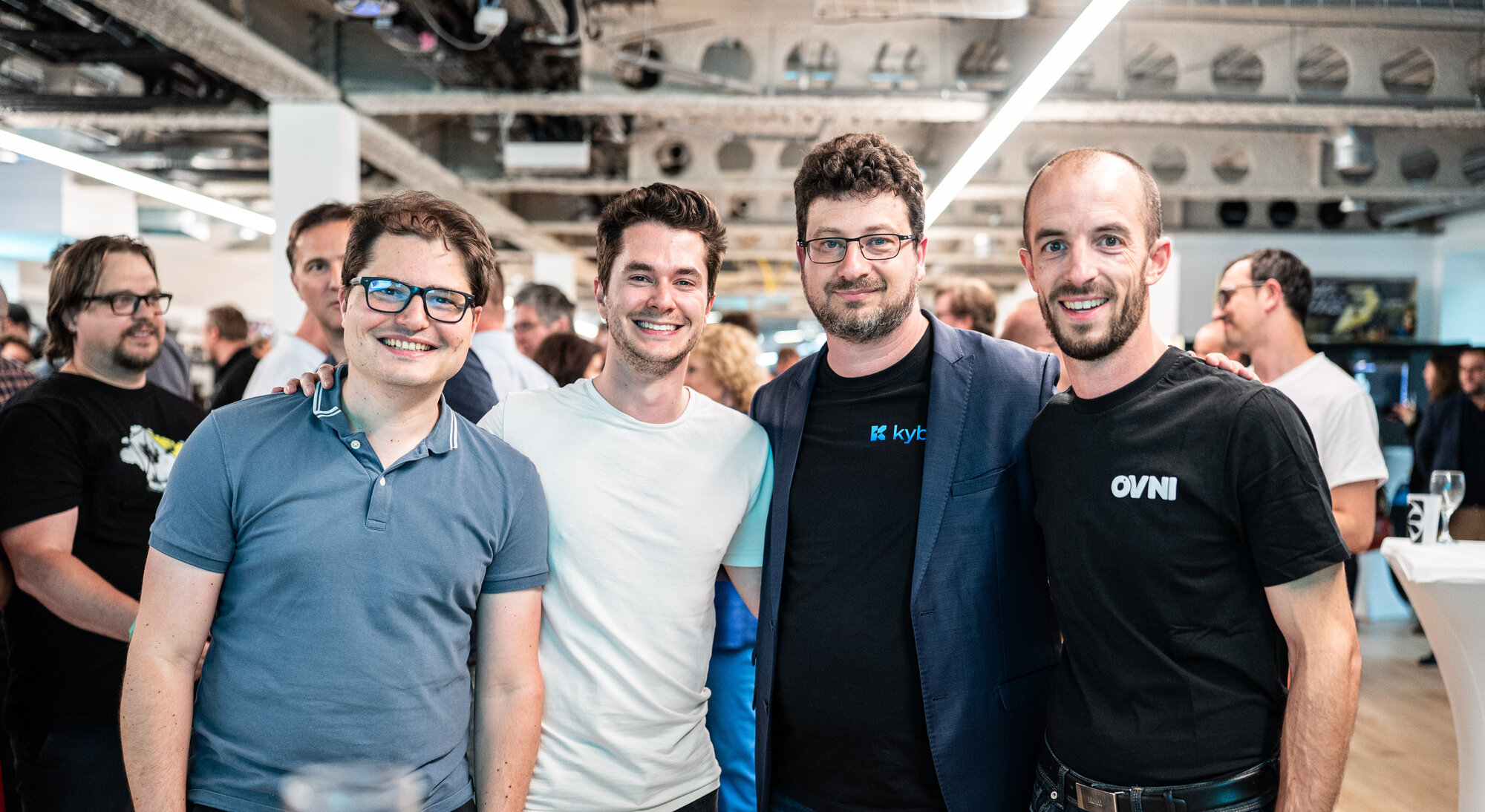
Thanks to Morgan Dollard, Michael Cheng, Colleen Kelly Henry, Anders Bo Pedersen, Simon Laroque, Matthew McClure and Jon Dahl, who’ve helped me immensely in building the company.
Thanks also to Luke Curley, Alex Giladi, Kieran Kunhya and Nathan Egge for their technical advice and our many discussions, and to many others from the multimedia community.
And of course, to Xavier Niel, Aude Durand and my former colleagues at Scaleway, who believed in me long before Kyber.
We have amazing people, very cool technology and very big ambitions. If you want to use Kyber, contribute to it or build with us, get in touch. And we’re hiring! Especially geeks. :)
It’s time for real-time.